

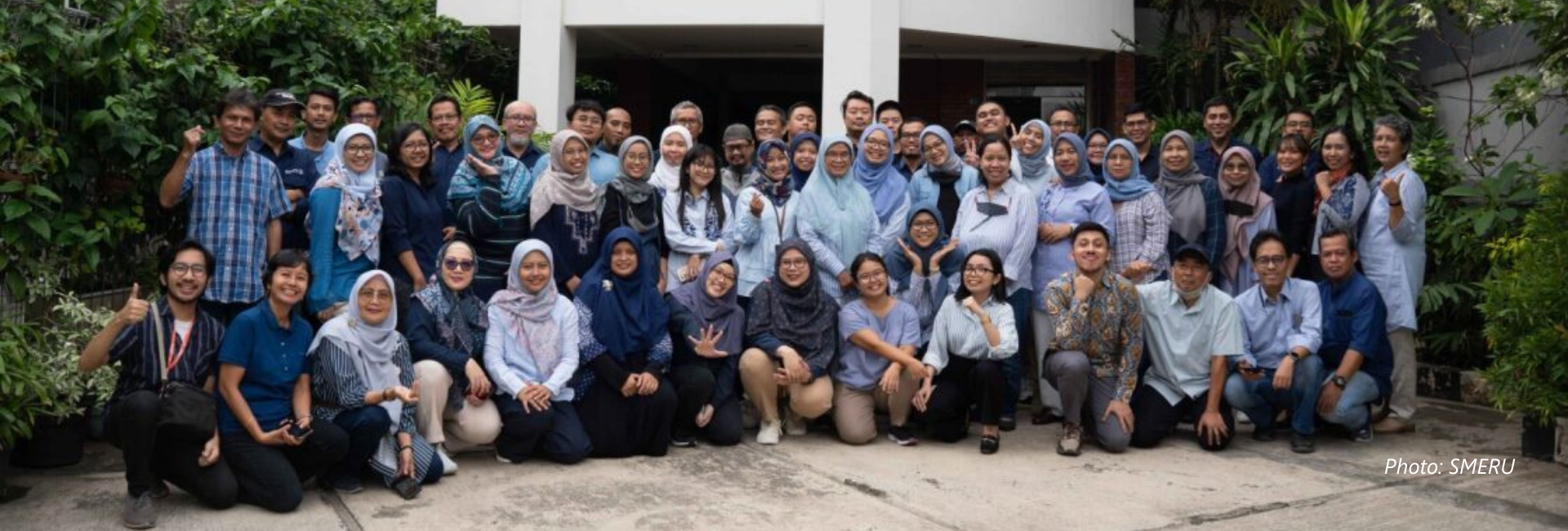
The beginning of 2026 marks a quarter century of SMERU’s contributions to advancing evidence-based policymaking. As we celebrate our 25th anniversary this year, I would like to pause and reflect on SMERU’s long journey in generating high-quality evidence to support more effective and better-targeted public policies.
Born in a Time of Transformation
SMERU was established amid Indonesia’s major transition in the late 1990s. We began operating independently in 2001, during the country’s recovery from the Asian financial crisis and at the dawn of the reformation era and regional autonomy. At that historic juncture, SMERU stepped forward to ensure that social and economic issues remained central to public policymaking.
Since the beginning, we have focused on research that informs the development of social and economic policies, particularly in areas such as social protection systems, decentralization and regional autonomy, as well as poverty and vulnerability. Our mission, then and now, has remained the same: to ensure that development delivers greater benefits for the poor and vulnerable.
Starting out as an independent, nongovernmental research institution was not easy. In our early years, we grew with short-term funding support from various bilateral agencies, international philanthropic organizations, and trust funds. That support enabled us to build our capacity and reputation by conducting rigorous research and consistently communicating our findings with integrity to relevant stakeholders.
The knowledge, relationships, and networks accumulated by our founders and researchers became the foundation for the institution’s development. By building on this initial capital, while steadfastly maintaining research quality and independence, we gradually earned broader trust, both from funding partners and from policymakers who continue to receive our input and engage with us in policy dialogues.
Becoming a Critical Partner in Policymaking
From the very beginning, we recognized that the process of formulating public policy is rarely linear, especially in the context of a democratic transition, when spaces for public participation become increasingly open. Policymakers often face new and complex dynamics, and they require credible input to navigate them. It is here that we see our role: as a critical partner providing constructive and research-based input so that social and economic policies can better serve the poor and vulnerable.
To better understand policymakers’ perspectives and the challenges they face, we chose to engage them from the earliest stages of our research, starting from the design phase through to the development of policy recommendations. This approach helps bridge the worlds of research and policy, while also fostering trust in the findings we produce.
Of course, not all research findings are readily embraced by policymakers. Yet through open and sustained dialogue, mutual trust and understanding can grow, allowing us to work together in identifying the most effective policy solutions, without compromising the independence of our research.
Bridging the National, Local, and Public Stakeholders
Although much of our work takes place at the national level, we recognize that strengthening the capacity of policymakers at the local level is just as essential. Sound policies must be understood and translated in ways that reflect local contexts. With this in mind, we initiated the Regional Development Forum, a platform for dialogue that brings together local governments, national-level policymakers, and research findings relevant to regional development challenges. Through this forum, we seek to bridge policy conversations and foster stronger connections between the center and the local governments.
From the outset, we have also understood that influencing public policy cannot rely solely on engagement with decision-makers. The public plays a vital role in the process. For this reason, we believe research findings must be widely accessible. Our dissemination strategy has evolved accordingly; from distributing printed reports to stakeholders to building active dialogue with them, beginning at the planning stage through the formulation of policy recommendations.
We have also expanded access to information by strengthening civil society networks and adapting to digital platforms and social media, ensuring that SMERU’s ideas remain relevant and inclusive. Through this journey, we have learned that advocacy is not merely about “informing” policymakers, but about building an information ecosystem that engages the public. Broad participation creates social support, making evidence-based policies stronger and harder to ignore.
Expanding the Scope, Sustaining the Mission
Over time, we came to understand that poverty never exists in isolation. It intersects with age, gender, disability, and geography. This awareness encouraged us to step beyond our comfort zone and explore an increasingly diverse range of issues—from village governance and the impact of the pandemic on people’s lives, to future challenges, such as digitalization, the climate crisis, and the energy transition. In our view, policies in any sector must take poverty, vulnerability, and inequality into account if the benefits of development are to be shared more equitably.
As we began working on new issues, we faced at least two major challenges. The first was internal, related to our understanding of the issues themselves. Mastery of a subject is essential to identify existing or potential poverty-related problems. This required us to keep learning—deepening our engagement with the literature, consulting with experts, and collaborating with a wide range of stakeholders. The second challenge came from sectors and policymakers who had yet to fully recognize the importance of addressing poverty-related dimensions. Many prioritized sectoral targets without adequately considering the social consequences that might arise in the process of achieving them. Patience and persistence were needed to continue offering constructive input so that the social implications of every policy would be duly considered.
Amid this expanding scope and role, we also faced shifting research funding dynamics. In general, funding for research tends to be more limited compared to programs with immediately visible impacts. Changes in the priorities of both global and domestic donors have posed real challenges for independent institutions like SMERU. Yet within this uncertainty, we found renewed clarity of mission: that regardless of the changes around us, the voices of disadvantaged groups must continue to have advocates.
We have also come to realize that SMERU’s sustainability depends on our ability to remain relevant without compromising our integrity. To this end, we have expanded partnerships with research institutions both domestically and internationally, and opened avenues for collaboration with the private sector to strengthen our institutional independence. As research funding becomes increasingly constrained, we must develop new funding approaches to ensure that knowledge-sharing efforts continue. We have begun implementing a user-pay approach, whereby beneficiaries contribute to the services and knowledge they receive. It is from this initiative that we established the SMERU Learning Centre as a platform for knowledge transfer.
Moving Forward, Together
As we look back on this quarter-century journey, we are filled with gratitude for the support of our development partners, donor institutions, government counterparts, academics, private sector actors, and civil society organizations who have walked alongside us. Without sustained collaboration and dialogue, efforts to advance evidence-based policymaking would not carry the same momentum. The trust you have placed in us is the energy that keeps the integrity of our research alive.
This 25th anniversary is not the end of our journey, but a stepping stone toward the road ahead. Looking forward, SMERU is committed to continuing its transformation into a more inclusive and adaptive center of excellence. We will strengthen cross-sector collaboration and equip younger generations with the knowledge and tools needed to respond to increasingly complex challenges. We invite you to continue this journey with us, ensuring that future public policies remain rooted in evidence, guided by empathy, and aligned with the needs of those who require support the most.
Author(s)
SMERU's blog posts reflect the views of the authors and do not necessarily represent the views of the organization or its funders.