

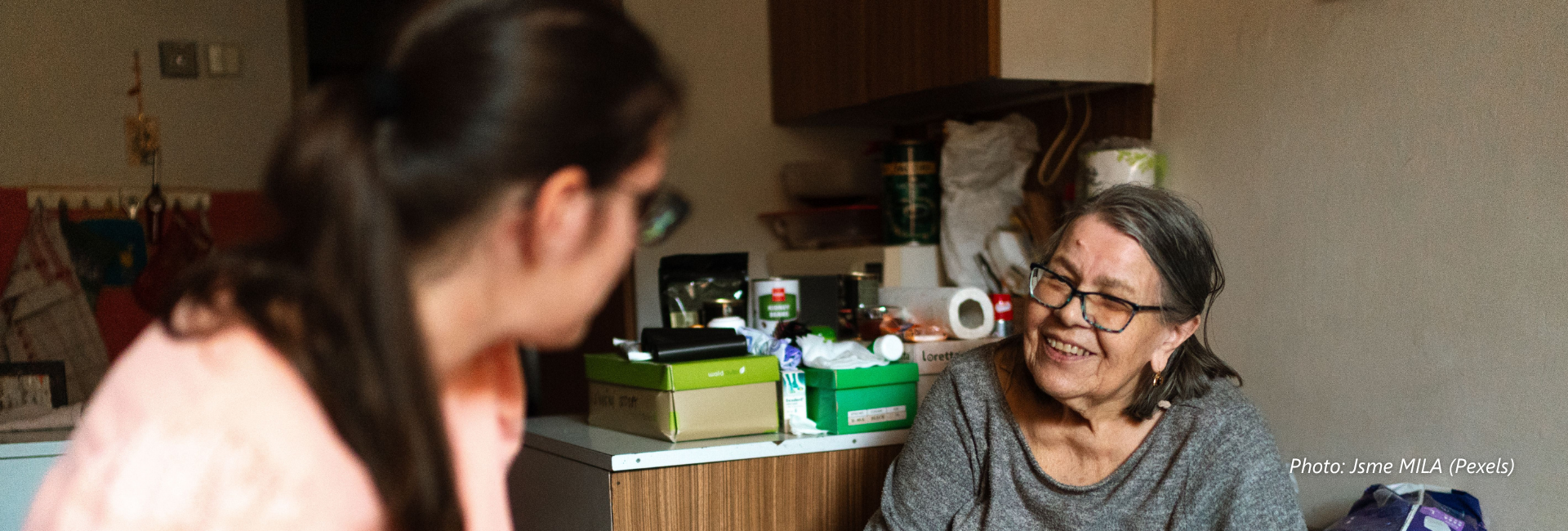
The women participating in the FGD handed their children mobile devices to keep them settled. They kept track of how much water their children drank and even shared their own drinking water with them. The women also explained the name-tag stickers to their children, helped them understand what was happening at the event, and made sure the snacks provided suited their children's preferences—for example, by removing bread toppings their children did not like. (Researcher’s notes, FGD with community in South Jakarta, 18 January 2025)
These observation notes were recorded as part of the data collection for the study “Future Demand for Care: Lessons from Indonesia”, which maps the care work landscape in Indonesia, particularly childcare, older people’s care, and disability care. During the focus group discussions (FGDs), the male participants came alone. In contrast, some of the women brought their young children—or even their grandchildren—with them.
While taking part in the discussions, the mothers were also busy caring for, supervising, and responding to their children's needs. This pattern of multitasking is not an exception; rather, it reflects how deeply care work is woven into women's everyday lives. In this article, we highlight how traditional gender norms leave women shouldering multiple layers of care responsibilities, particularly when it comes to childcare.
Traditional Gender Norms in Care Work: Women and Caregiving
Care work—from caring for babies and looking after sick children to caring for older people, preparing packed meals, and cleaning the house—is still often seen as the natural duty of women. These activities take place “behind the scenes”, are unpaid or poorly paid, and rarely receive recognition. Our findings reinforce a substantial body of research showing that care work is assumed to be a moral duty of women—mothers, wives, daughters, or other female relatives.
This understanding means that when men perform care work, their actions are seen as “help” rather than a responsibility that men should ordinarily share. The notion that men merely help women fulfil their care responsibilities—for example, by feeding their own children—often leads to men being glorified simply for being “willing” to feed them. Yet feeding a child should be an ordinary part of being either a father or a mother. Social norms that position women as the primary caregivers in their families also perpetuate the idea that men are “not supposed to” care for children.
In one of our men-only FGDs in Padang, we observed how strongly participants understood the division of labour in their communities as being based on sex.
Yes, just my wife [takes care of the children]. Here in Minang, most [men] don't get involved [in caring for children]; it's only the women. For us men, our job is just to work. So we don't really know about family matters. All we know is the financial side. She says she needs money, and that's it. And all this time, I've been busy going here and there. (FGD with community, Padang, 1 February, 2025)
This understanding of the “customary” way care work is managed has been institutionalised through legal instruments such as Law No. 1 of 1974 on Marriage. The law perpetuates a rigid division of domestic roles: the state assigns the responsibility for providing for and protecting the family exclusively to the husband, while assigning household affairs to the wife. Article 31(3) and Article 34(1) and (2) structurally entrench these gender norms. When economic necessity drives women to enter the labour market and take on their “first shift”, the Marriage Law does not legally release them from their “second shift” of caring for the home and family. As a result, women work around the clock, 24 hours a day.
The Dilemma of Working Women
Indonesia has made progress toward achieving gender equality in education. Girls outnumber boys from primary through secondary school, and women also outnumber men at the undergraduate level. However, this progress is not reflected in the labor force. According to 2024 data from Statistics Indonesia (BPS), the female labor force participation rate (LFPR) stood at 56.42%, far below the male rate of 84.66%.
One factor behind the stagnation of women’s LFPR is the large number of women who leave the workforce after getting married and/or having children. One FGD participant in South Jakarta shared that she stopped working after giving birth because she felt it was “a mother's duty”. In Yogyakarta, another participant left her job as a store administrative staff member after giving birth to her third child. Previously, the store owner had allowed her to bring her two young children to work. However, after her third child was born, she felt uncomfortable asking for permission to bring all three children with her, as there was no one to look after them at home and she could not afford childcare services.
These examples illustrate how caregiving responsibilities are assigned to women and treated as a private matter rather than a shared responsibility among the state, workplaces, the market, and workers. The stigma that caregiving is women's domain remains deeply entrenched, reflecting gender norms that position men as the primary breadwinners and women as caregivers in the domestic sphere. These findings underscore that gender norms not only influence individual decisions but also shape the structure of opportunities available to women in the labour market.
Childcare Policies and Practices in Indonesia
Our study examines future care needs through the lens of the care economy. Through the 2025–2045 National Long-Term Development Plan (RPJPN), the Government of Indonesia has committed to integrating care policies in a more systematic and inclusive manner. One manifestation of this commitment is the Care Economy Roadmap and National Action Plan, which sets out seven policy directions that provide a foundation for strengthening Indonesia's care system.
The roadmap not only highlights the need for care services but also emphasizes the fulfilment of the rights of caregivers who provide care. Since mid-2025, the Ministry of Women's Empowerment and Child Protection (Kementerian PPPA), as the lead agency, has led an interministerial and interagency working group to ensure that the roadmap is widely communicated and implemented.
One important issue highlighted by our study is how people perceive paid care services. Many members of the public and policymakers still believe that caregiving should be provided exclusively by families. Even those who wish to access paid services, such as childcare centres, are often constrained by the high cost of private care and the lack of guaranteed service quality.
When no relatives are available to help look after children, many families rely on domestic workers (pekerja rumah tangga/PRT) as a more affordable alternative. However, domestic workers often work without contracts, leaving them vulnerable in terms of wages, working hours, and social security. This reliance on informal care arrangements presents a challenge in its own right for Indonesia's care system.
On the other hand, Indonesia's maternity leave policy under Law No. 4 of 2024 on Maternal and Child Welfare frames childcare responsibilities as the exclusive domain of mothers. Article 4 explicitly sets out the rights of “working mothers”, rather than using a more inclusive term such as “working parents”. This choice of language reinforces the view that caregiving is a woman's responsibility.
This approach differs from that of Japan, which promotes the redistribution of caregiving responsibilities through paid paternity leave equivalent to 30 weeks of full pay, increasing fathers’ participation to 30% in 2025. Meanwhile, in Quebec, Canada, the 1997 Educational Childcare Act provides universal, low-cost childcare services, ensuring access for all preschool-aged children regardless of their parents' economic or employment status.
In addition to the limited implementation of paternity leave, Indonesia has yet to establish employment policies such as flexible work arrangement (FWA) that could help parents access care services. To date, FWA options have only been formally established in the government sector through Government Regulation No. 94 of 2021 and Minister for State Apparatus Empowerment and Bureaucratic Reform Regulation No. 4 of 2025. This suggests that many workers continue to face difficulties in meeting their childcare needs.
Care for Our Shared Future
Our findings show that care work, particularly childcare, continues to be treated as “women's business”, while the existing care system remains inadequate in supporting the needs of families across Indonesia. Policy reform is crucial to changing this situation. The establishment of the Care Economy Roadmap and the enactment of the Domestic Workers Protection Law are important first steps towards recognizing the vital role of care work in our collective well-being. The universal adoption of FWA across the private sector and the revision of provisions in the Marriage Law that reinforce traditional gender roles are also urgently needed to create a care ecosystem that better supports women.
The experiences of other countries show that an equitable care economy ecosystem can be built through a combination of policies that support the redistribution of caregiving responsibilities and public investment in services. Indonesia needs to take similar steps by providing high-quality, affordable, and widely accessible care services nationwide. By strengthening these policy and service foundations, Indonesia can build a fair and sustainable care economy while creating greater opportunities for women to thrive without having to sacrifice their well-being.
Keywords: care economy, childcare, gender roles
This reflective article shares insights collected whilst completing research for Future Demand for Care Work: Lessons from Indonesia - a research project funded by the Australian Government through the Investing in Women initiative. The views expressed in this publication are the author’s alone and are not necessarily the views of the Australian Government. The Australian Government neither endorses the views in this publication, nor vouches for the accuracy or completeness of the information contained within the publication.
Author(s)

SMERU's blog posts reflect the views of the authors and do not necessarily represent the views of the organization or its funders.
SMERU's blog posts reflect the views of the authors and do not necessarily represent the views of the organization or its funders.

SMERU's blog posts reflect the views of the authors and do not necessarily represent the views of the organization or its funders.