

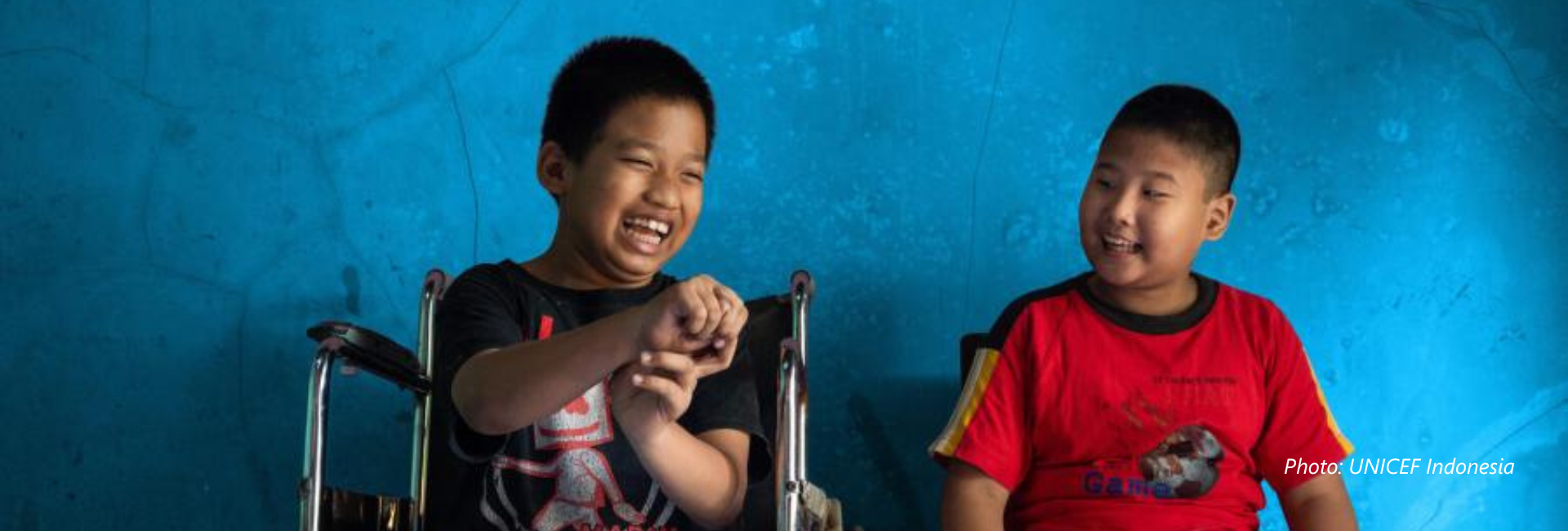
Approximately 3.3% of Indonesian children aged 5–17 have disabilities. The government has launched various policies and social protection programs to support them, but these measures still fall short of meeting all their needs. Families raising children with disabilities must shoulder much higher caregiving costs than other families. Current social assistance programs, including PKH, PIP, ATENSI, and BPJS Kesehatan, have not been able to fully cover these additional expenses.
The 2023 UNICEF Landscape Analysis highlights this gap clearly. Many children with disabilities still struggle to access the social protection support they need. An estimated 17% live in poverty, making them considerably more vulnerable than their peers without disabilities. This economic disadvantage restricts their ability to access education, healthcare, and nutritious food.
A recent study further underscores the financial strain experienced by families raising children with disabilities. Only the wealthiest 20% of households are able to cover the monthly costs linked to disability. For children and adolescents, education expenses alone can reach between IDR 1.7 million and 5.35 million each month—revealing the considerable burden families are facing.
These conditions highlight the urgent need to improve social protection programs so they can better meet the high costs of caring for children with disabilities. For this reason, reliable evidence is crucial to help policymakers design more inclusive and responsive social protection systems.
Southern African Social Policy Research Insights (SASPRI) has been commissioned by UNICEF Indonesia, the Ministry of Finance, and Bappenas to conduct a study estimating the cost of caring for children with disabilities. Recognizing the importance of strong local knowledge, SASPRI has brought in The SMERU Research Institute to carry out the study.
The study comprises four key activities.
- Review the current landscape of child disability in Indonesia
- Analyze expenditure patterns among households with children with disabilities
- Develop a framework for estimating the cost of caring for children with disabilities
- Prepare a report and present the study’s findings
This study has the following objectives.
- Estimate the cost of caring for children with disabilities across different wealth quintiles and compare it to the cost of caring for children without disabilities.
- Estimate the total additional cost of care nationwide over the next five years and identify the available fiscal resources to cover these expenses.
- Develop a policy paper to reform the social protection programs based on the findings of the cost estimation of caring for children with disabilities, highlighting the impact of inaction.
- Conduct high-level policy discussions to agree on reforming the existing benefits level of key social assistance programs.
This study uses a mixed-methods design, combining quantitative analysis of household expenditure data, a literature review, and qualitative focus groups with caregivers and key stakeholders. Activities include
- reviewing the child disability landscape;
- analyzing expenditure patterns using SUSENAS data to estimate additional costs of raising children with disabilities;
- defining a cost framework based on the Minimum Essential Standard of Living (MESL) adapted to Indonesia; and
- validating assumptions and refining the estimates through continuous stakeholder engagement and focus group discussions.