

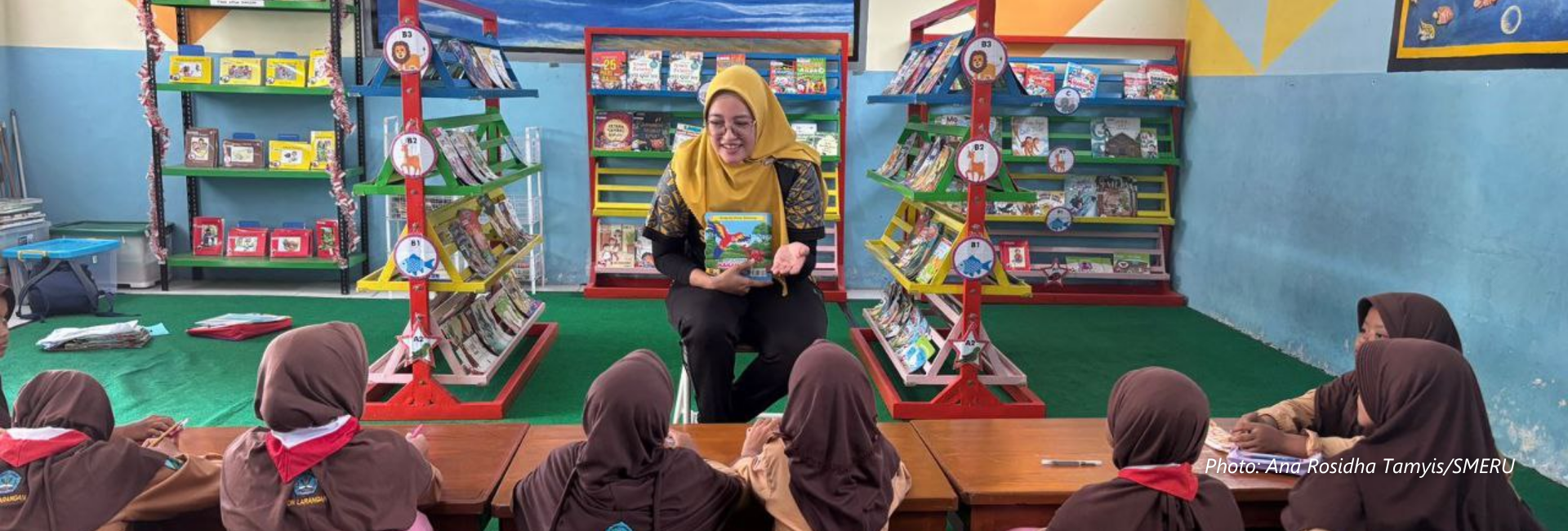
Indonesia continues to face a significant literacy challenge, as national assessments frequently highlight a gap between school enrollment and actual reading proficiency. Despite the government’s National Literacy Movement, many students, particularly in remote regions, lack access to the high-quality, age-appropriate reading materials and engaging learning environments essential for developing foundational cognitive skills.
The Room to Read Indonesia program, established in 2014, addresses these gaps through targeted support for book publishing and child-friendly library establishment. In collaboration with ProVisi Mandiri Pratama, the program has trained approximately 200 authors and illustrators to produce 130 original storybooks, alongside establishing child-friendly school libraries in five regions of Indonesia. To ensure these libraries function as sustainable hubs for active reading rather than mere storage spaces, the initiative provides technical training for teachers and puts formal book checkout systems in place. The intervention is implemented over an 18-month period, beginning with 4 months of setup and capacity building, followed by 14 months of intensive monitoring and ongoing support. The evaluation was conducted approximatley 3 months into monitoring and support.
To determine the impact of these efforts, SMERU conducts an evaluation of the program in East Lombok, West Nusa Tenggara. This study assesses the program’s effectiveness in fostering reading habits while identifying best practices and implementation challenges. The resulting evidence-based insights will inform future programming and guide policymakers, implementers, and stakeholders in scaling successful approaches to enhance literacy rates and educational equity across Indonesia.
The study aims to learn the influence of the program intervention on the reading habits of children. Data of children from both treatment and selected comparing schools are collected to assess whether the program effectively enhance reading habits among children. Moreover, the study also try to assess the scalability and the sustainability of the program in the study area.
The evaluation focuses on four primary objectives:
- Assess the effectiveness of the intervention in improving reading habits within the targeted population.
- Evaluate the relevance of the program’s design and implementation in addressing the specific needs of school communities.
- Analyze the sustainability of the program’s outcomes and its potential for long-term impact.
- Generate actionable recommendations to inform policy decisions and enhance the design, delivery, and scalability of future literacy initiatives.
This study uses a mixed-methods approach, combining numerical data with personal stories to provide a complete picture of the program’s impact.
- Quantitative Surveys and Field Observations
We conduct surveys with students to measure changes in their reading frequency and skill levels over time. Additionally, researchers perform onsite observations to record how often children use the libraries and which books they engage with most.
- Qualitative Stakeholder Interviews
Our team holds in-depth discussions with school staff and local government officials to understand the successes and challenges of managing the libraries. We also speak with families at the household level to learn how reading habits are being supported or shared within the home.